


|
|
First, an accessible representation of human musical gestures is available through electronic keyboards and musical controllers. Second, the improvisations being studied here feature a large-scale structure that provides both a nominal sequence of roles for the computer and a basis for evaluating the utterances of others. Third, a repeating harmonic structure governs the construction of syntactically correct musical utterances. Furthermore, an examination of literature about group improvisation yields numerous references to its conversational qualities. I believe results from Conversation Analysis can inform the design of an interactive music system that will both track the changing roles of participants in a musical improvisation and synchronously generate appropriate contributions of its own.
Many human-computer interaction researchers have concluded that people regard interactive computer systems as social actors [17,22]. In Lucy Suchman's study of human interactions with photocopiers [21], copier users analyzed failures in their interaction with the copier in terms of a turn-taking dialogue. Users became frustrated when their expectation that the copier would "take its turn" was not fulfilled. If a photocopier, with its limited sensors and simple interactions, provokes these kinds of attitudes, it stands to reason that users will expect as much from a computer system that parses a continuous stream of musical data and responds in real time.
Because they respond to stimuli, interactive music systems exhibit a kind of conversation. Furthermore, the collaboration they are attempting to engage in has many conversational qualities. In this context, it is important to design systems which fulfill users' expectation of turn-taking. To improve the way these improvisations conform to human social expectations, interactive music systems can be informed by the sociology of conversation.
Critics of the use of Conversation Analysis in CSCW (see, for example, [2]) assert: (1) that rules derived from observing conversation should serve as a resource for interaction, not an implementation of it; and, (2) that the asymmetry in interactional capability between humans and machines eliminates the possibility of real conversation or interaction. Even in the face of these complaints, lessons learned from conversation analysis yield important design insights for interactive music systems. As Graham Button says, "...I do not want to suggest that a computational model of conversation cannot reproduce something that might appear to be ... a simulacrum of conversation." [2]
Conversation analysis suggests several requirements for successful conversation participation. Each of these requirements contributes to the design of a musical improvisation system. In both improvisation and conversation, a participant must:
IB also distinguishes itself by being an equal partner in the improvisation, soloing and accompanying, except that it does not take initiative in choosing tempos or altering harmonic structure. The human performers may improvise freely, provided they adhere to the computer's tempo. The framework's design rests on the premise that improvisation is a conversation.
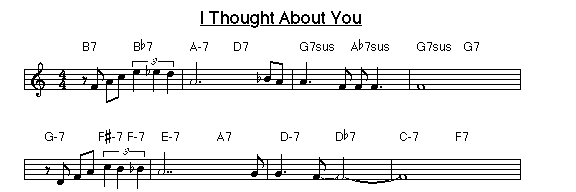
The prevailing style of small group jazz includes a set of large-scale structures designed to coordinate the group's activities. These structures form a body of shared knowledge very much like the one discussed in Heath and Luff's paper on collaboration in the London Underground control room [10]:
"These practices appear to stand independently of particular personnel, and it is not unusual to witness individuals who have no previous experience working together, informally, yet systematically coordinating their conduct."Jazz musicians are often called on at short notice to perform with musicians they have never worked with before. Jazz musicians also participate in jam sessions, during which the same conditions apply. The presence of a shared structure for jazz performance allows these performances to proceed.
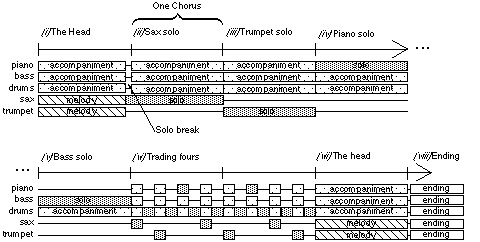
Each repetition of the song's harmonic structure is called a chorus. Initially, some subset of the musicians play the song's melody (the head) during the first chorus while the rhythm section (piano, guitar, bass, drums) accompanies (i). The accompaniment is improvised from the harmonic structure of the song, and is designed to complement the melody. A soloist then improvises a melodic line for one or more choruses (ii). During the solo, the rhythm section continues to improvise an accompaniment, reacting to and supporting the soloist. The second soloist follows immediately for further choruses (iii).
Note that the performers equipped with such a road map still have to negotiate many issues during the performance, such as the order of soloists, whether the optional trading will take place, and when to end the trading.
Throughout the solos (ii)--(v), verbal and visual cues are used to coordinate accompaniment and solo. Each solo usually takes several choruses, allowing the soloist time to explore several musical ideas or elaborate on the melody. At some point during the solos, one of the players may raise four fingers to propose "trading fours," a standard procedure for exchanging shorter improvisations amongst the musicians.
If the proposal is accepted, the trading begins immediately following the last solo (vi). Soloists reappear in the same order they soloed in, each playing a four measure fragment. When the band contains a drummer, the drummer injects a four measure phrase after each soloist. The four measure solos are accompanied, but the drummer's contributions are not. Deciding when to stop trading fours is complicated by the fact that, depending on the number of soloists, the end of the chorus may not coincide with each soloist having gotten an equal number of chances (Figure 2 shows an uneven allocation of phrases during trading fours). Eventually, a musician will pat the top of his head to propose playing the melody of the song one last time (vii) followed by an ending (viii).
Some musicians make these kinds of negotiations an explicit part of the performance. In James Brown's performances of "Sex Machine," he engages in several shouting matches with the rest of the band, such as "Can I take it to the bridge?" "Yeah!" and "Can I hit it and quit?" "Yeah!" to mark transitions between various parts of the song [1]. While trading fours, musicians often respond musically to each other's playing. Hartmann [9] wrote:
"A four measure phrase leaves the player enough room (say, three to six seconds) to develop one idea, to make one statement; yet there is no mistaking the dialogue within which each statement takes its place, and often the musicians answer each other directly. The resemblance to conversation is uncanny."The analogy proposed here is central to the design of my system. I view jazz improvisation as a conversation. It is a sequence of spontaneous utterances constructed within a collaborative structure that is interactively managed by the group. This collaboration fosters the interchange of ideas and encourages participants to express themselves. I will further develop this analogy by examining conversation analysis and considering its relevance to musical improvisation.
Conversation Analysis findings are descriptions of behaviors derived from the researcher's analysis of recorded ordinary talk. These descriptions, often formulated as rules, are resources in maintaining the smooth flow of conversation.
One example of Conversation Analysis is Gail Jefferson's study [11] of list-making in conversation and how it relates to turn-taking. The study reports on the predominance of three part lists in a corpus of transcribed conversations. This rule of three manifests itself in both speaker and listener behavior. Speakers produce lists of three items, and can rely on listeners to expect the end of a turn after the third list item. Listeners will wait for the expected third list item, and can even cooperate in completing the list if the speaker appears to be having difficulty doing so. This is an example of the fundamental premise of Conversation Analysis that participants employ these rules as resources for speaking and listening and expect others to do likewise.
"When we say that the inside audience has structural competence, we mean that they can recognize basic elements in what is being played as it is being played.... The rest of the listeners--the outside audience--really do not hear or understand improvised solos... it may be as meaningful in some way for us to hear an impassioned--but untranslated--speech by the prime minister of Japan, especially if we see and hear it in its original context... we'll never know exactly what the prime minister said." (p. 181)The following section presents some preliminary rules for musical improvisation by analogy with results from conversation analysis.
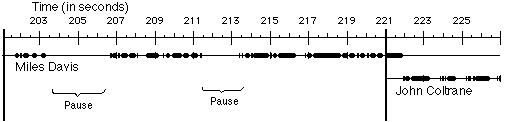
In the jazz context, musicians build melodic solos from phrases. The end of each phrase is thus a transition relevance place. Musicians assess these places by consulting the harmonic structure of the tune being performed. Solos are almost always an integral number of choruses. Thus, if a gap occurs in at the end of a chorus, it is much more likely to signal the end of a solo than if it occurs somewhere in the middle.
Figure 4 shows a time line representing musical activity in an excerpt from Miles Davis' "Freddie Freeloader" [4]. As Davis' solo draws to a close it contains a number of gaps that might suggest he is finished. Coltrane does not begin playing during those gaps since they occur in the middle of a chorus. The real end of the solo comes slightly after the chorus boundary at 221 seconds, and Coltrane begins immediately thereafter at time 222 seconds. While the two musicians may also have employed visual cues, the smoothness of this transition is based in part on Coltrane's use of tune's harmonic structure to project the end of the solo. Group agreement on the location of transition relevance places allows for smooth transitions between speakers or soloists without accidental overlap or gap.
Speakers employ two strategies to allocate the next turn. The speaker-selects-next strategy requires the speaker to specifically indicate which listener should speak next. For example, the speaker may direct a question to a specific listener. The self-selection strategy requires a listener to begin speaking at a transition relevance place. In the context of jazz improvisation, musicians use the same two strategies. Sometimes soloists use a visual or verbal cue to indicate who should follow them, while other soloists simply end their turn and leave allocation of the next solo to their colleagues.
In the next section I will discuss the implementation of a jazz improvisation system within the IB framework. In addition to providing an overall philosophical grounding for writing interactive music software, the preceding analysis of conversation and improvisation yields three rules that directly inform the implementation of a jazz improvisor:
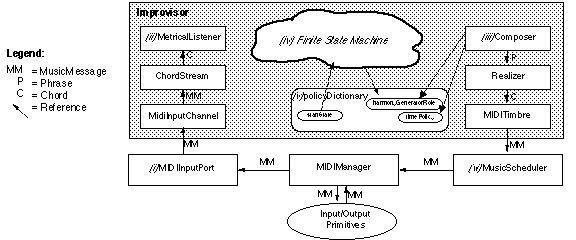
The ImprovisationBuilder framework provides Smalltalk-80 classes corresponding to the tasks performed by improvising systems. Listeners process the incoming music, parsing it into phrases and focusing the system's attention. Transformers and Composers create new phrases, either by transforming phrases captured by the listener or by some compositional algorithm. Realizers express musical ideas appropriately, both through real-time presentation and by controlling Timbres that represent sound generating hardware. Improvisors monitor the information gathered by Listeners and use it to track progress through a map of the shared musical structure.
By providing a class hierarchy of components for improvising systems, ImprovisationBuilder facilitates rapid testing and prototyping through the combination of existing components [12]. Users can extend the framework by adding their own components to it. These new components reuse code provided by their superclasses and only implement the unique aspects of their behavior. ImprovisationBuilder also provides a standard representation of musical events for use by all components.
ImprovisorComponents are combined in a linear chain, with a Listener at one end and a Timbre at the other. This chain of components is contained within an Improvisor, along with all the information the computer uses to improvise. A typical configuration of components is shown in Figure 5. This figure also shows the MusicScheduler (vi) and other support components. They connect any number of Improvisors to input and output devices and handle scheduling details. The following sections describe the components of the framework.
The Listener can also compare the incoming musical stream to the harmonic structure of the tune being performed. This allows the Listener to translate specific phrases into generalized material, independent of particular keys or scales. The Composer uses such generalized material as one basis for its improvisation.

The HarmonyGenerator provides variety by combining several strategies for generating melodies. One strategy involves concatenating short melodic fragments ("riffs") to produce a solo. Beginning human improvisors often employ this tactic as they develop their own style, and even the most experienced players tend to rely more on their favorite riffs when playing at rapid tempos. The other strategy for generating melodies is to simply perform a random walk on the scale appropriate to the current chord structure. While this strategy alone is inadequate, it helps to separate the riffs and highlight them. Walking bass lines are also generated by fitting together short patterns. The HarmonyGenerator constructs chords using rules found in the piano jazz instruction materials of Tony Caramia [3].
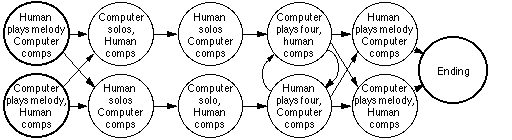
Each state specifies a criterion for whether improvisational roles are about to change. An Accompany state interprets the appearance of bass notes in the input to mean that the other player is assuming the role of accompanist. Conversely, a Solo state interprets the appearance of treble notes to mean that the other player is beginning a solo (see Figure 6). When the current state satisfies its transition criterion, it passes control to the next state, which will give new instructions to the HarmonyGenerator and specify its own transition criterion. In accordance with the placement of transition relevance places, most transition criteria are tested at the end of each chorus, since roles usually change on chorus boundaries.
Figure 7 shows a sample finite state machine for a two piano performance. The state machine is based on a simplified version of the structure in Figure 2. With only two players, the choices about who plays the melody and the order of soloing are greatly simplified. One of the players plays the melody, followed by one of the players taking the first solo. The other player then takes the second solo. The process of trading fours in the absence of a drummer means the two performers exchange four bar phrases directly, enhancing their conversational quality. This special case of group jazz improvisation is easily represented in a small number of states.
In the second scenario, the composer builds an environment from off-the-shelf software. Off-the-shelf systems offer a difficult trade-off: they either remain "aesthetically neutral" by offering low-level constructs and services (requiring additional effort from the composer), or they contain some significant musical assumptions (which may not coincide with the composer's vision). I believe the ideal process for developing interactive music software is one in which composer and programmer engage in an iterative, collaborative design process.
ImprovisationBuilder succeeds largely because of an iterative, collaborative design process known in the Apple Advanced Prototyping Laboratory as situated prototyping. Believing that contrived, sterile laboratory conditions offer no real context for testing the usability or utility of an artifact, our goal is to get working prototypes into the hands of real users as early and as frequently as possible. By observing how these prototypes succeed or fail, we learn valuable lessons that inform the next prototype. Two composers have used ImprovisationBuilder extensively, and have had considerable impact on its present state.
Martirano's second generation system was the YahaSALmaMAC orchestra, consisting of Yamaha synthesizers driven by a LISP program called Sound and Logic (SAL). SAL processed the MIDI data from Martirano's music keyboard and created new musical gestures from his.
Martirano's working style was one of constant rehearsal and experimentation in his home studio. Thus, while I was developing IB and customizing it for his needs, I tried to ensure that a working version was installed in his studio at all times. This meant I was getting a steady stream of bug reports and feature requests during development. While some of the requests were largely cosmetic (such as the specifics of which keyboard keys were assigned to which commands), others had important structural implications for the implementation (such as the need to reconfigure software components during a musical performance).
Martirano's willingness to endure user-hostile interfaces and arcane initialization procedures made him the ideal user for situated prototyping.
We worked together to create some Transformer components, such as one for creating trills from sustained single notes and another for adding short ornamentation notes to the attack of single notes. As we wrote and debugged these algorithms together, he gained a greater understanding of IB's musical representation, while I came to understand how he intended these musical transformations to relate to the music he had composed for the pianist.
This foundation helped us to communicate when we resumed work in 1994, culminating in our premiere of "Cross-Town Traffic," a piece for two improvising pianists and IB in November of 1995. Each pianist's improvisation is transformed by a copy of IB. The transformed material is realized on the other pianists' piano while he is playing. While each of us used a distinct IB configuration, our mutual understanding of the implementation and musical consequences of each other's IB configuration greatly aided our improvisation [24].
In practice, ImprovisationBuilder's performance is quite respectable, and has great promise as a jazz teaching tool. Where traditional "music minus one" recordings allow students to practice improvising over a fixed accompaniment, IB lets them practice accompanying, soloing, and when to switch between them. While the bass lines and melodies generated by the system are rather formulaic, its ability to detect the beginnings and endings of solos and borrow from the human performer's solo allow much more interaction than playing along with a prefabricated accompaniment.
Collaboration in the domain of jazz improvisation appears to benefit from the insights of Conversation Analysis. This result confirms the writings of Paul McIlvenny, Paul Luff, and Robin Wooffitt in Computers and Conversation [15]. They argue that conversation analysis has important insights for all of human-computer interaction because it proceeds in an empirical manner and produces results which can inform software design.
In the future, I plan to continue improving the generality and reusability of ImprovisationBuilder through continuing design iterations and musical experiments. I hope the architecture presented here will prove sufficiently general to explore the issues raised by computer participation in various aspects of computer-supported collaborative work, such as structural flexibility for workflow systems or better representation of cooperation in shared editing.
2. Button, G., Going Up a Blind Alley: Conflating Conversation Analysis and Computational Modelling, in Computers and Conversation, P. Luff, N. Gilbert, andD. Frohlich, Editors. 1990, Academic Press Limited: London. p. 67-90.
3. Caramia, T., A Guide for Jazz Piano Harmonization. 1983, San Diego: Neil A. Kjos Music Company.
4. Davis, M., Kind of Blue 1959, Columbia: New York.
5. Ellinger, J. and M. Baker, MiBAC&tm; Jazz Improvisation Software 1990, MiBAC Music Software: Northfield, Minnesota.
6. Franco, S., Hardware Design of a Real-Time Musical System, 1974. Doctoral Dissertation, University of Illinois at Urbana-Champaign.
7. Giomi, F. and M. Ligabue. An Interactive System for Music Improvisation in Proceedings of the International Computer Music Conference (Cologne, Germany, 1988), ICMA, 47-63.
8. Gridley, M., Jazz Styles. 1985, Englewood Cliffs: Prentice-Hall.
9. Hartmann, C., Jazz Text: Voice and Improvisation in Poetry, Jazz and Song. 1991, Princeton: Princeton University Press.
10. Heath, C. and P. Luff. Collaborative Activity and Technological Design in Proceedings of ECSCW `91 1991), 65-80.
11. Jefferson, G., List construction as a Task and Resource, in Interaction Competence, G. Psathas, Editor. 1990, University Press of America: Lanham.
12. Johnson, R. and B. Foote, Designing Reusable Classes. Journal of Object-Oriented Programming, 1988. 1(2): p. 22--35.
13. Kaplan, S., A. Carroll, and K. MacGregor, Supporting Collaborative Processes with ConversationBuilder. ACM Special Interest Group in Office Information Systems, 1991. 12(2/3).
14. Levitt, D., A Melody Description System for Jazz Improvisation, 1981. Master's Thesis, Massachussets Institute of Technology.
15. Luff, P., N. Gilbert, and D. Frolich, ed. Computers and Conversation. Computers and People Series, eds. B. Gaines and A. Monk. 1990, Academic Press: London. 284.
16. Martirano, S., A Salvatore Martirano Retrospective: 1962-1992 1995, Centaur Records: Baton Rouge.
17. Nass, C., et al., Can computer personalities be human personalities? International Journal of Human-Computer Studies, 1995. 43: p. 223-239.
18. Pachet, F. Representing Knowledge Used by Jazz Musicians in Proceedings of the International Computer Music Conference (Montréal, 1991), ICMA, 285-288.
19. Perlman, A. and D. Greenblatt, Miles Davis Meets Noam Chomsky: Some Observations on Jazz Improvisation and Language Structure, in The Sign in Music and Language, W. Steiner, Editor. 1981, University of Texas Press: Austin.
20. Sacks, H., E. Schegloff, and G. Jefferson, A Simplest Systematics for the Organization of Turn-taking for Conversation. Language: Journal of the Linguistic Society of America, 1974. 50(4): p. 39.
21. Suchmann, L., Plans and Situated Actions. 1987, Cambridge: Cambridge University Press.
22. Turkle, S., The Second Self: Computer and the Human Spirit. 1984, New York: Simon and Schuster.
23. Ulrich, J. The analysis and synthesis of jazz by computer in Fifth International Joint Conference on Artificial Intelligence (Cambridge, MA, 1977), William Kaufmann, 865-872.
24. Walker, W. and B. Belet. Applying ImprovisationBuilder to Interactive Composition with MIDI Piano in Proceedings of the International Computer Music Conference (Hong Kong, 1996), ICMA, 386-389.
25. Walker, W., K. Hebel, S. Martirano, and C. Scaletti. ImprovisationBuilder: Improvisation as Conversation in Proceedings of the International Computer Music Conference (San Jose, 1992), ICMA, 190-193.
|
|